14 minutes
Cryptopals - Set 2
The second set of the cryptopals challenges focuses on block ciphers. Everything is encrypted using AES, but the cipher itself isn’t important - all attacks take advantage of a weak mode of operation. The lesson here is that no matter how secure your underlying block cipher is, you can still introduce catastrophic security holes by messing up the way the blocks are combined together.
Most of the tasks focus on thoroughly breaking the ECB mode, which is the simplest mode of operation imaginable (discussed before). Towards the end, we also start breaking the CBC mode, which we will then continue in Set 3.
As before, my implementation can be found on GitHub.
Lessons learned
We mostly learned not to use block ciphers, because even if the encryption algorithm (such as AES) is secure, the mode of operation can break the cipher in non-obvious ways.
- Block ciphers need their input padded to the block size (Challenge 09).
- An oracle represents the system being attacked. It has access to information we as an attacker do not, such as the encryption keys (Challenge 11).
- Don’t use block ciphers in the ECB mode, the plaintext can be decrypted (Challenge 12, Challenge 14).
- Don’t use block ciphers in the ECB mode, the blocks can be cut and pasted. This allows the attacker to manipulate the ciphertext in a way that affects the plaintext, even if your API validation is correct (Challenge 13).
- Don’t use block ciphers in the CBC mode, the ciphertext can be edited in a way that affects the plaintext (Challenge 16).
Challenge 09
The ninth challenge has us implement the PKCS#7 padding scheme, which is a particular way of padding a message with extra bytes to be a multiple of the cipher’s block size.
The PKCS#7 padding scheme works by appending N copies of the byte N, so that length(message) + N becomes a multiple of the block size. For example, to pad the message HELLO to length 8, we need 3 bytes, and the result will be
HELLO\x03\x03\x03
The only thing to watch out for is that even when the message length already is a multiple of the block size, we still need to add one full block of padding. This is because if the message happened to end with a valid padding, the unpadding routine would strip it, corrupting the message.
Because we will need an unpadding function later, I went ahead and implemented it as well.
Challenge 10
In the tenth challenge, we implement the CBC mode of operation. Compared to ECB, the CBC mode no longer makes the individual blocks independent and XORs the previous ciphertext with the current decrypted block. The first plaintext block, which has no previous ciphertext, instead uses a “fake ciphertext” called the initialization vector (IV).
Wikipedia has excellent diagrams that explain this better. Here is how the encryption works: 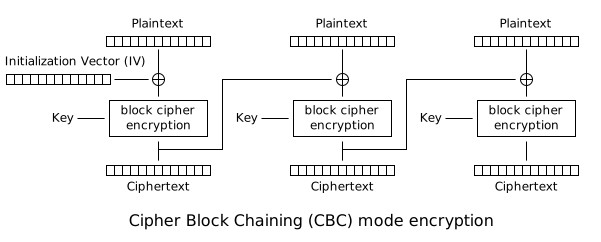 Notice that the encryption process cannot parallelize over blocks, because to encrypt a block, we need to XOR it with the previous ciphertext block.
The decryption process works like this: 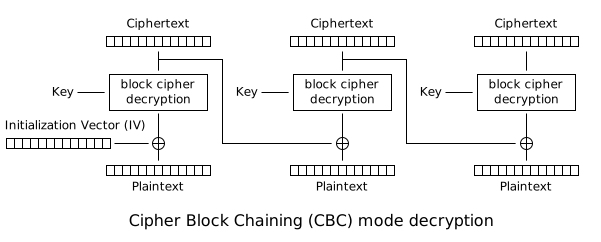 Compared to encryption, decryption can run in parallel because we only need the ciphertext blocks, not the plaintext.
Although it seems like an improvement over ECB, we will later see that the CBC mode is also completely broken, because it allows the attacker to manipulate the plaintext, and under some circumstances, even decrypt it.
Challenge 11
One more preparation task before we start breaking crypto. Here we implement an oracle that takes our input, prepends a random prefix and appends a random suffix. It then flips a coin and randomly encrypts the result in either ECB or CBC mode. Our task is to detect which mode was used by only looking at the ciphertext.
An oracle represents the system we are attacking - we can ask it questions about an input and receive answers, but it has access to information we don’t (for example the encryption key).
To detect which mode of operation was used, we take advantage of the fact that ECB always encrypts the same plaintext block to the same ciphertext block. Because AES uses block size of 16 bytes and the first 5-10 bytes are occupied by the random prefix, we pass in 3 x 16 equal bytes (for example the letter ‘A’). The first block is scrambled by the random prefix, so we throw it away. We then look at the following two blocks of ciphertext. If they are equal, we know the encryption mode was ECB.
We could make the oracle also return which mode was used to be able to unit test it. I ended up just running the detector many times, counting the frequencies of both modes, and checking that they were more or less equal.
Challenge 12
We implement an oracle that accepts a plaintext, appends an unknown string to it, encrypt the result under the ECB mode, and returns the resulting ciphertext. It turns out that we can recover the unknown suffix by repeated calls to the oracle with suitably crafted input, without knowing the encryption key. It works like this:
-
Determine the cipher’s block size.
We know that the oracle is using AES whose block size is 16 bytes, but this makes the solution more general. We try a range of values (I went for 2-64), create a buffer twice as large filled with the letter ‘A’, and append ‘B’ to it. We then feed this buffer to the oracle, and use our ECB detection code from Challenge 08. The reason we append ‘B’ to the buffer of A’s is to cover for the case where the unknown suffix happened to start with ‘A’, messing up our count by one.
-
Build a mapping between encrypted blocks and plaintext bytes.
Knowing the block size, we can now create a bytestring filled with ‘A’ that’s exactly one letter shorter than the block size. If we feed it to the oracle, it will append the unknown suffix, making its first byte appear in the last position of the block. It will then return the corresponding ciphertext. We can determine this first byte by a simple dictionary lookup.
We build a dictionary that looks like this:
ciphertext(AAAAAAAAAAAAAAAA) -> A
ciphertext(AAAAAAAAAAAAAAAB) -> B
ciphertext(AAAAAAAAAAAAAAAC) -> C
...
repeating for all 256 possible bytes.
When we later call the oracle with an input 1 byte shorter, we can isolate the first block and lookup the ciphertext in this dictionary, obtaining the first letter of the unknown suffix.
-
Recover the unknown suffix one byte at a time.
Rather than me attempting to explain this, it might be helpful to see what happens in four interesting scenarios. To make it shorter, we will assume block size of 8 bytes. The unknown suffix is
UNKNOWNSUFFIX, with padding shown asP. The question mark?symbolizes the byte we iterate when learning the dictionary above.- Decrypting the first byte
learning the mapping: AAAAAAA? UNKNOWNS UFFIXPPP query to the oracle: AAAAAAA complete plaintext: AAAAAAAU NKNOWNSU FFIXPPPP ^^^^^^^^ ciphertext of this is the key to the learned mapping- Decrypting the second byte
learning the mapping: AAAAAAU? NKNOWNSU FFIXPPPP query to the oracle: AAAAAA complete plaintext: AAAAAAUN KNOWNSUF FIXPPPPP ^^^^^^^^ ciphertext of this is the key to the learned mapping- Decrypting the eighth byte (the last in the first block)
learning the mapping: UNKNOWN? SUFFIXPP query to the oracle: <empty> complete plaintext: UNKNOWNS UFFIXPPP ^^^^^^^^ ciphertext of this is the key to the learned mapping- Decrypting the ninth byte (the first in the second block)
learning the mapping:
NKNOWNS?
UFFIXPPP

query to the oracle: AAAAAAA
complete plaintext:  AAAAAAAU NKNOWNSU FFIXPPPP
                              ^^^^^^^^
                              ciphertext of this is the key to the learned mapping
                     ^^^^^^^^ drop this, we have already processed the first block
We see that the padding with A’s becomes irrelevant when learning the mapping between the encrypted blocks and the plaintext bytes. It’s only necessary at the beginning when we do not yet have a full block’s worth of decrypted plaintext. We can build the dictionary key as
key = oracle(bytestring[N-block-size:N])[0:block-size]

where N = length(bytestring)
      bytestring = (<padding> || <decrypted part of the suffix> || b)
      padding is a string of A's block-size long
      b iterates between 0 and 255 (inclusive)
Finally, we need to come up with a formula to determine how many A’s to include in the query to the oracle. After a bit of thinking, I came up with this:
(block-size - length(decrypted-bytes) - 1) mod block-sizeThis works with the four scenarios above:
(8 - 0 - 1) mod 8 = 7 mod 8 = 7(8 - 1 - 1) mod 8 = 6 mod 8 = 6(8 - 7 - 1) mod 8 = 0 mod 8 = 0(8 - 8 - 1) mod 8 = -1 mod 8 = 7
The interpretation is that we need to start with
block-sizeA’s when we haven’t yet decrypted anything, subtract the number of decrypted bytes (because we keep needing fewer A’s as we decrypt), subtract 1 (because we need to iterate the last byte), and take the modulo byblock-size(because we never need more than one full block.
The neat thing here is that because we can query for one byte at a time and all the bytes are independent of each other, the complexity of the attack is linear with respect to the suffix length, not exponential. For each suffix byte, we only need to iterate over 256 possible bytes.
Challenge 13
We are given an API that, given an email address, returns an encrypted URL-encoded cookie that authenticates a user with that email as a regular user. The API itself is well-written and properly escapes all special characters, so we can’t just inject arbitrary input. Still, because the cookie is encrypted under the ECB mode, we can edit it to instead authenticate as the admin. That is, change
AES-ECB([email protected]&uid=10&role=user)
into
AES-ECB([email protected]&uid=10&role=admin)
without ever decrypting it.
I decided to implement the URL encoding properly using Go’s net/url.Values type. This is the correct thing to do, but it complicated the task, because its ordering is non-deterministic (the Value type is an alias for map[string][]string). I decided to cover two cases - one where the encoding follows the ordering given in the task ([email protected]&uid=10&role=user) and another that I actually observed ([email protected]&role=user&uid=10). The other permutations wouldn’t be difficult to cover if needed.
The attack again takes advantage of the ECB mode encrypting the same blocks to the same ciphertext. This time, we will craft a suitable email input and cut the resulting ciphertext into blocks. We will then rearrange them and obtain a ciphertext representing an admin cookie. I didn’t bother with the email input being a valid address, but it would be trivial to change this.
- Ordering
[email protected]&uid=10&role=user
We need to create one block that begins with admin and another block that ends with role=. We will then use them to assemble an admin cookie. The admin and role= strings must be at the block boundaries, because we cannot just slice into the middle of a block - that would scramble the contents.
The following two email queries return the cookies displayed below (divided into blocks for readability):
email = AAAAAAAAAAadmin
                 block1           block2           block3
cookie = AES-ECB(email=AAAAAAAAAA admin&uid=10&rol e=userPPPPPPPPPP)

email = AAAAAAAAAAAAA
                 block4           block5           block6
cookie = AES-ECB(email=AAAAAAAAAA AAA&uid=10&role= userPPPPPPPPPPPP)
We will assemble the admin cookie by combining blocks 1, 5, 2 and 3:
admin-cookie = block1 || block5 || block2 || block3
             = email=AAAAAAAAAA || AAA&uid=10&role= || admin&uid=10&rol || e=userPPPPPPPPPP
- Ordering
[email protected]&role=user&uid=10
The idea is similar, but we need a slightly different input because of the different ordering:
email = AAAAAAAAAAadmin
                 block1           block2           block3
cookie = AES-ECB(email=AAAAAAAAAA admin&uid=10&rol e=userPPPPPPPPPP)

email = AAAA
                 block4           block5
cookie = AES-ECB(email=AAAA&role= user&uid=10PPPPP)
The assembled admin cookie is this:
admin-cookie = block4 || block2 || block3
             = email=AAAA&role= || admin&uid=10&rol || e=userPPPPPPPPPP
Challenge 14
This challenge is a more difficult variation of Challenge 12. This time, the oracle also prepends a random prefix to the input string before encrypting. Before, the oracle did
suffix-oracle(input-string) = AES-ECB(input-string || target-suffix, unknown-key)
This time, it does
prefix-suffix-oracle(input-string) = AES-ECB(random-prefix || input-string || target-suffix, unknown-key)
We know neither the random prefix nor its length. Same as in Challenge 12, we want to retrieve target-suffix by repeatedly querying the oracle with a suitably crafted input-string. Our goal here is to reduce the challenge to Challenge 12, so that we can reuse our attack.
This would be really easy if we happened to know the length of random-prefix and it was a multiple of the block size. We could simply call our attack from Challenge 12 with the following oracle function:
oracle(input-string) = prefix-suffix-oracle(input-string)[prefix-length:]
The prefix length being a multiple of the block size is important; otherwise slicing it away wouldn’t work. That’s because the bytes exceeding the block size would get encrypted into the same block as the first part of the input string, making it unreadable.
Let’s now generalize slightly. We will still assume the length is known, but now it’s no longer a multiple of the block size. We need to pass enough padding to prefix-suffix-oracle from Challenge 12 to reach a block boundary. We will do
oracle(input-string) = prefix-suffix-oracle(padding || input-string)[prefix-length + padding-length:]
where padding is an arbitrary bytestring of padding-length bytes, and padding-length is block-size - prefix-length mod block-size. That is, we need as much padding as there is missing from the prefix length to reach the block size.
All that remains is to find the prefix length. We do this by passing two equal blocks to the oracle, taking again advantage of the fact that ECB encrypts the same plaintext to the same ciphertext. We will then iterate over the ciphertext and detect the position where a block equal to the following block begins. This by itself would again work only if the prefix length was a multiple of the block size, so we will prepend with a padding whose length iterates between 0 and 15 (the AES block size - 1, inclusive). Schematically:
prefix-suffix-oracle(padding || AAAAAAAAAAAAAAAA AAAAAAAAAAAAAAAA || S)

where padding is a string of P's padding-length long
      padding-length iterates between 0 and 15 (inclusive)
We append an S after the repeated blocks (“separator”) just in case the target string begins with the letter A. The prefix length is then start - padding-length, where start is the index in the ciphertext where the first AAAAAAAAAAAAAAAA block begins.
This works under two assumptions:
- We already know that the block size is 16 (the AES block size). We could instead try a few common values here.
- The random prefix contains no neighboring repeated blocks. If it did, we could instead detect the repetition starting from the end of the ciphertext. If even the unknown suffix repeated blocks, we would just collect all repetition starts and try them one by one.
Challenge 15
This challenge simply has us implement a PKCS#7 unpad function, which I already did in Challenge 09. The function must signal when the padding is invalid; this is something we will use later in Set 3 to implement a CBC padding oracle attack.
Challenge 16
The last challenge of this set is a variation on Challenge 13. The cookie now consists of a fixed prefix, our input, and a fixed suffix. This time, it is encrypted under the CBC mode. The input is again sanitized, and our task is again to become an admin by editing the ciphertext. That is, given
ciphertext(input) = AES-CBC(prefix || sanitize(input) || suffix)
we have to edit ciphertext(input) so that it contains ;admin=true;.
Coming back to the CBC decryption diagram, we see that each block of ciphertext is XORed with the next decrypted block to form the plaintext block:
If we edit a position in the ciphertext block, it will completely scramble the corresponding plaintext block, but the same edit will propagate to the following plaintext block. We can use that.
The authors of the challenge were kind enough to prepend a prefix that’s 32 bytes long, so our input starts at a block boundary. We will obtain a cookie like this:
input = "AadminAtrueAAAAA"
cookie = ciphertext(input)
Our goal is to convert the first three A’s into ;, = and ;, respectively.
From the CBC decryption diagram, we know that we need to edit the preceding ciphertext block and that it will be XORed with the following decrypted block. We can craft a new ciphertext like this:
edited-block     = ciphertext[16:32]
edited-block[0]  = edited-block[0]  XOR input[0]  XOR ';'  # 0 is the position of the first A
edited-block[6]  = edited-block[6]  XOR input[6]  XOR '='  # 6 is the position of the second A
edited-block[11] = edited-block[11] XOR input[11] XOR ';'  # 11 is the position of the third A

new-ciphertext = ciphertext[0:16] + edited-block + ciphertext[32:length(new-ciphertext)]
(We again assume a known block size of 16 bytes).
When decrypting, the input[0], input[6] and input[11] will be XORed to the same values in the decrypted block and cancel themselves out, leaving us with the bytes for ;, = and ;. The plaintext block whose ciphertext we edited will be completely unreadable, but the following block will become ;admin=true;AAAA.
2848 Words
2026-07-09 18:45